
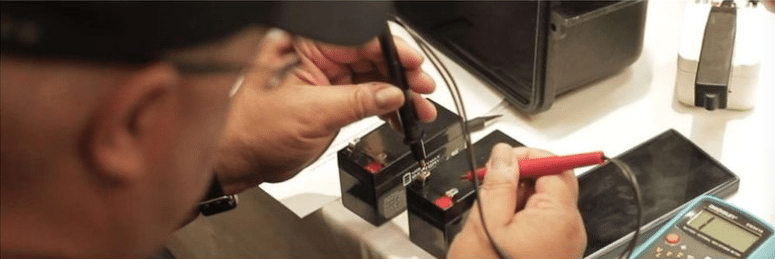
Battery testing, for most of us, is a very simple process: get out there, do a charger test, make sure the charger is doing its job to make sure batteries are being charged, and discharge test to make sure batteries can pump back into the panel what’s needed, or if your jurisdiction allows for it using of pulse load tester. Well, for some of us, this simple process may have become more complicated or at least more involved. As of the 2019 edition of NFPA 72, there are now more battery tests and a change of the batteries being utilized (VRLA batteries now instead of sealed lead acid batteries). With these new tests come new requirements, and depending on where the work is being done, the jurisdiction may only require one or two of these or multiple different tests, and this is where things can become frustrating, especially if you may not be familiar with these tests and the testing requirements as well as equipment being utilized for them. So, let’s become familiar. Let’s learn what the new tests are, their frequencies, when we must do them, and what tools or equipment we need.
VRLA stands for valve-regulated lead acid batteries. These are the same things as our sealed lead acid batteries. Most of us are already accustomed to working with the only difference is the name. With that not too much to worry about, the code has now eliminated the usage of most other battery types, so in 2019, the only batteries within the code are these valve-regulated batteries or primary (dry cell) batteries. The inspection requirement for VRLA batteries is a semiannual inspection for the date code markings to verify the battery is not past its 3-to-5-year manufacturer “freshness” date. For the frequency of testing for most of the new tests, testing is required mostly on a semiannual basis, with load tests or replacements being a maximum of every three years unless, of course, your jurisdiction or panel manufacturer requires more frequency.
Prior editions of 72 had about three tests for the batteries, those being the charger test, discharge test, and load test. Well, in 2019, the number of tests has gone up, with charger, discharge, and load testing still being required, but we do see the addition of temperature testing, cell/unit voltage testing, and ohmic testing. Each of these tests has its requirements, and for some of them, specialized equipment/tools are necessary.
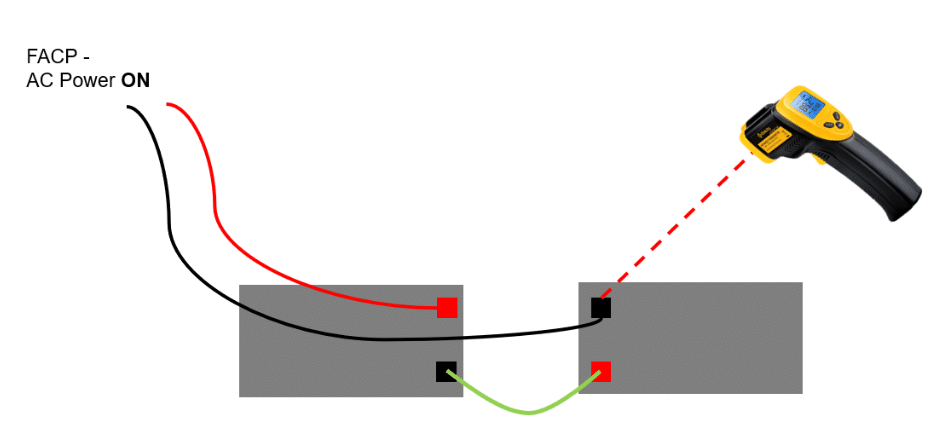
Temperature testing requires the usage of an infrared thermometer, which is the very first test that is performed upon initially opening the fire alarm control panel. Using our IR thermometer, we are going to measure the temperature of the batteries at the negative terminal as soon as we can. The reason we perform this first is that the longer the door is open, the more heat escapes and our readings are not a true indication of the battery’s temperature when the door is closed. After reading about the batteries, we must find out the ambient temperature of the cabinet, so get your ambient temperature of the cabinet, preferably somewhere away from heat sources. We are looking for a difference of 18 degrees higher. If our batteries are 18 degrees hotter than the ambient temperature, we are going to be looking to replace the batteries, for 18 degrees higher than ambient battery life is cut in half.
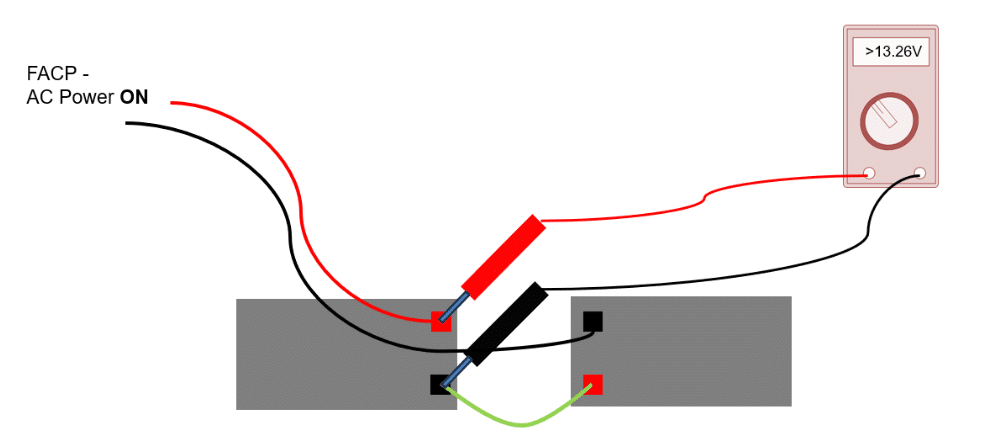
With the cell/unit voltage test, we are going to leave the batteries connected to the panel and charger and measure the voltage of each battery individually, which ensures each battery is being charged evenly. If either battery has a reading of less than 13.26 volts, we replace the battery. Now, depending on company policy, the replacement of batteries typically is performed in pairs, meaning if one battery fails, both are replaced. NFPA 72 does not stipulate this. Only if a battery is under 13.26 replacement is required. Best practices are considered, though, and most of the time, if one fails, both batteries are usually replaced.
Now, with ohmic testing, you need a specialized meter or battery tester, depending on which method is being utilized. There are two different methods, each with its requirements as well as meters. The first one is resistance/impedance, which requires a specialized meter for reading resistance or ohms. Note that the usage of a standard multimeter does not work as we are measuring extremely low resistance values. Typically, battery resistance levels are in the thousandths of ohms, and these meters are specialized for reading that low. Disconnect the batteries from the charger and measure each battery individually. Prior to interval testing, a baseline value must be taken as we are comparing our findings to the baseline, with the threshold for replacing being a greater than 40% change in resistance from baseline.

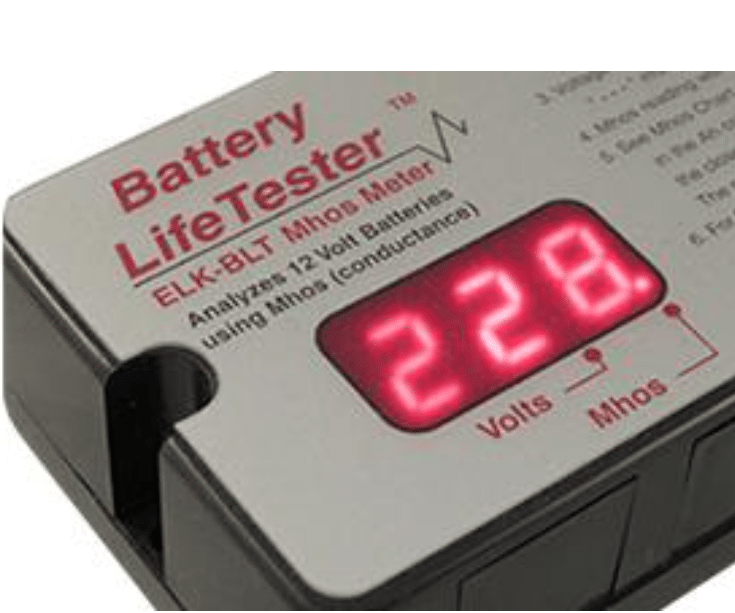
The next method for ohmic testing is conductance testing. We are measuring conductance, which is the inverse of ohms and is referred to as Mhos. Like our resistance/impedance testing, we need to have a baseline value against which to compare. Also, the batteries are disconnected from the charger and panel. To test, you connect clips to each terminal, and the meter displays voltage first, then Mhos. If there is a 30% downward change from the baseline, a replacement battery is required.
With all these new tests, it can be difficult to do something as simple as battery inspection and testing, well these new tests and requirements may only be being used in jurisdictions in which NFPA 72 2019 or a newer edition is required, and to find out more about where you work, consult with your AHJ and learn more about which edition of code they are using and which testing methods they are requiring.
