
Egress Devices for Access Control
Egress, or exit, is a critical part of an access control system. Getting into the facility is important, but being able to get out, especially in an emergency, can be a matter of life and death. The egress portion of most access control systems must be designed to be simple and understandable. It must be intuitive so that no special training is required to exit, even in an emergency.
Building and life safety codes, like the International Building Code (IBC) or NFPA 101 (Life Safety Code), drive egress requirements. These codes determine the buildings’ egress requirements and regulations on electrically locked access control doors. These codes use building classifications (Use Groups in the IBC, Occupancy in NFPA 101) to specify building construction and life safety requirements. These requirements also include egress requirements to ensure occupants can safely evacuate the building.
The architect determines these classifications when the building is designed and enforced by local code officials. Anyone designing systems impacted by these code requirements must design them to comply with the requirements specified in the referenced code. Most access-controlled doors allow free egress, meaning no code or credential is required to exit through an access door. While this is the most common type of egress, it is also the least secure. In this case, a credential is required to enter through the door, but nothing other than the ability to physically go through the door is required to exit.
Exit Push Button
Exit push buttons provide a manual means of unlocking the electronic locking device. The exit push button is a mechanical switch that opens or closes one or more electrical contacts. The exit push button will typically unlock the locking device directly by applying power (electric strike) or disconnecting power (maglock). A second set of contacts may signal the access control panel’s request to exit input that the egress button has been activated to shunt the door monitoring during the egress period.


Control Unit Signaling
Standard egress buttons only unlock the door when the button is activated. Standard egress buttons present two problems to the access control system user. First, it uses the egress button as a two-handed operation (one to hit and hold the button, the other to open the door while the button is being held. Second, it only provides a momentary lock release for as long as the button is held.
The egress button can be connected to the access control panel’s request to exit input, which will keep the door unlocked for the programmed duration. Since the egress button is required to release the door directly, this would require a second contact closure or opening to signal the access control panel.

Some egress buttons have electronic or pneumatic time delays that allow the egress button to keep their contacts active after the button has been pressed and released, which allows the egress button to control lock release directly for a time even after the egress button has been released. The choice to use these buttons is not always that of the designer or installer. Sometimes, the local authority having jurisdiction (AHJ) may require them. The use depends upon how the life safety codes the municipality uses are interpreted.
Egress Bars
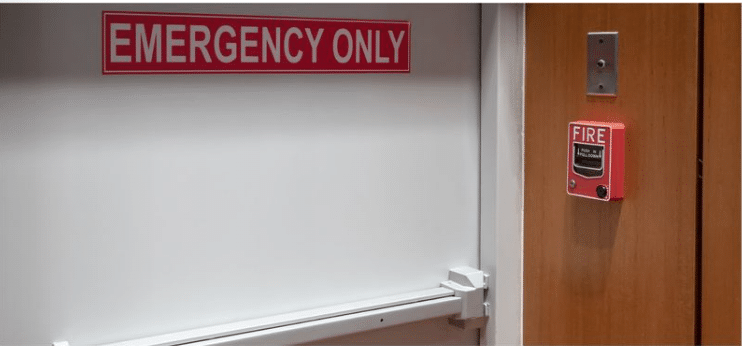
Egress bars are mounted to the door and appear similar to rim exit hardware. These egress devices are available as standard mechanical switches or electronic “touch” sensing types. The bars are available in the standard door widths, and some can even be cut in the field for non-standard door widths. The bars typically have the same features as egress push buttons.

Egress bars may be electronic (sometimes called “touch” bars) or mechanical. Electronic egress bars have a built-in proximity sensor that senses a human touch and releases the bar. These egress bars have no moving parts to wear out and typically last longer than mechanical bars. They are also typically more expensive than mechanical bars.
Mechanical egress bars have a moving bar assembly that activates a switch when pressed. Mechanical egress bars are less expensive than electronic egress bars, but since they have moving parts, they are more prone to breakage than electronic egress bars.
Since the switch for egress bars is on the door itself, rather than next to the door, like push buttons, the switch wiring must be installed from the door frame to the egress bar. Wiring from the egress bar must be on the hinge side of the door.
A power transfer device, such as an armored door cord, stationary electrical connection, power transfer loop, or electrified hinge, can accomplish a circuit connection from the door to the frame. These are the same devices that are used for the door-mounted electrical lock hardware.
Egress Motion
Egress motion detectors provide automatic door unlocking when an occupant approaches the door. Most commonly, passive infrared (PIR) detectors are mounted above the door and have a short-range detection pattern down and outward from the door. When an occupant approaches the door, the motion detector unlocks the door automatically for a programmed time. These detectors often also have a second set of contacts for connection to the access control panel to activate the request to exit input.

Egress motions must be positioned so that the detection occurs when someone approaches the door. Typically, this is accomplished by mounting the detector at the top of the door and adjusting the detection area out from the door. Ideally, the motion will only detect individuals approaching the door for egress, not anyone simply walking past the door.
The codes do not specify the mounting location of the egress motion or required detection area. Hence, the designer or installer has the flexibility to locate the detector for the best egress function. For example, mounting the motion offset from the door with a diagonally across the door can help prevent false egress detections. The pattern can even be narrowed so that detection occurs in a very narrow area of the door, like around the knob. The motion can even be wall-mounted on the side of the door instead of the top.
