

The NICET experience application is a component of NICET’s process for evaluating a candidate for NICET Certification. Passing the exam is only part of the requirement. Your experience must also be documented.
A common misconception about NICET’s work experience documentation process is that documenting work experience is required before taking an exam. While documenting adequate experience is a requirement for certification, it is essential to note that NICET does not review experience until after the exam has been completed. NICET indicates this fact when you begin the work experience documentation process.
To document your experience, log in to your account on NICET.org. From the main page, click ‘Apply’ to view available certifications. Next, select the certification you wish to work on and click “Save to Home” (if you have already saved it to your home page for your exam application, the certification will appear on your home page).
From the Home page, click “Apply Here” to submit your experience documentation.

At the top of the experience page, you must supply your verifier’s contact information (name and email address). Your verifier is your current immediate supervisor and must be the same person you list as your supervisor in your current position.

Enter your verifier’s name and email address, then click send. Your verifier will receive an email from NICET with a link to a form to complete, verifying your work experience. The form asks if you demonstrate essential traits and skills when performing your work. Once your verifier has completed the form, you will receive a notification on your account.
NICET requires the identification of a verifier to grant certification. NICET is not concerned with your verifier’s level of experience or qualification; they are only concerned that they have supervised your work and find it acceptable.
Even if you are in a position where you do not have a “supervisor,” you are still required to identify a verifier. For example, a company owner does not have a “supervisor,” but they do have someone who oversees their work. This oversight may be performed by an AHJ, engineer, or contractor under whose supervision the work is done. In this case, any of these individuals may serve as your verifier.
Work Experience
Documenting your work history is the next field on the form, and it is certainly the most critical part of the NICET Certification process. Achieving NICET Certification requires passing the appropriate exams and documenting adequate work experience for the certification level you seek.
For your initial application, NICET requires that you document your ENTIRE career. Therefore, even if you only seek Level I certification (which requires only 6 months of experience), you must document all of your work experience with the initial application.
NICET requires a comprehensive view of your experience with your initial application and may not accept any additional experience that was not provided after your initial application. Additionally, documenting your entire work history with the initial application covers the higher experience requirements needed as you seek higher levels of certification.
Beginning with your current position, identify your current employer, date of employment, position, supervisor’s name (this should be the same person identified as your verifier), city, state, and employment level.

At the bottom of the section, NICET requires that you identify and describe any Subfield/Technical Area (S/TA) relevant to your experience. For each S/TA, you need to briefly describe the work and the percentage of your overall work in this position performed in this area.
You must accurately and completely identify all work associated with your position. While NICET is primarily concerned with work in the area for which you seek certification, it also considers related experience when evaluating your application.
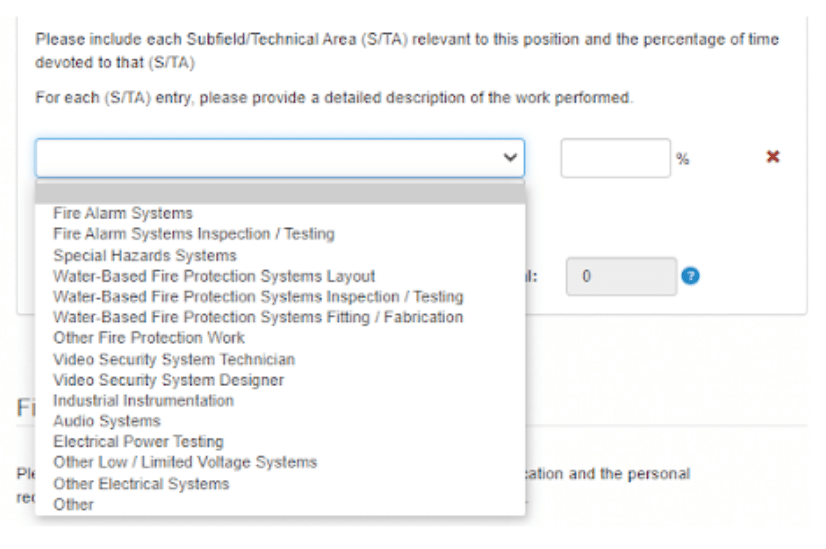
Clicking the plus sign allows you to add S/TA’s to your experience. After clicking the plus sign, a pull-down menu allows you to select from S/TA’s NICET recognizes for your certification.
Once you have identified an S/TA, identify the percentage of your work in this area to the right. Then, below the S/TA, provide NICET with a brief description of your work in this area.
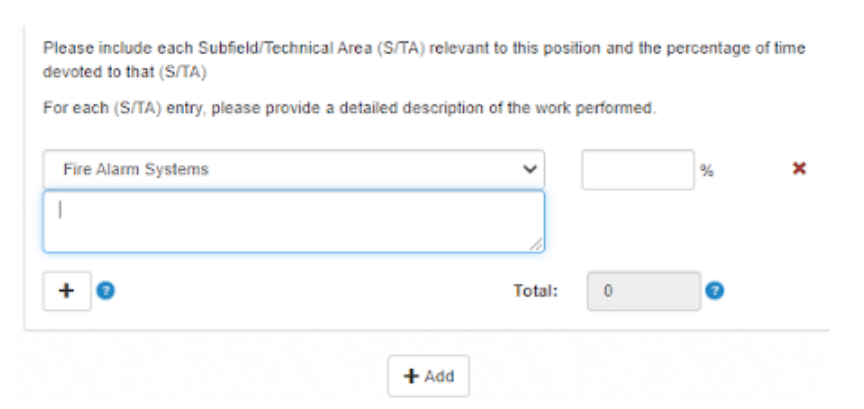
Click the plus sign below the selected S/TA to add S/TA to your current position. Provide percentages and descriptions for each S/TA added. The total percentages are indicated in the lower right. Your total for the S/TA must be 100%. NICET does not allow progression on the form until the total is 100%. NICET requires documentation of your entire work history with your initial application. Additional positions may be added to your experience by clicking the “+ Add” button below your current work history. Continue adding your work history until you have documented your entire career.
Changes in employer or position require starting a new work history section. For example, working as a technician, supervisor, and manager at your current employer would require three work history sections. Three additional work history sections would be required if you repeated the same career path at a different employer. Each work history section details the S/TA’s covered in that position, including percentages and descriptions. With a long work history, documenting your career could take some time.
There are several key points to consider when documenting your work history.
- Be as accurate as possible in your work history. List employers, dates, supervisors, and positions to the best of your recollection. When identifying and detailing S/TA’s to describe your position, pay attention to the details. NICET requires complete documentation of your career at the time of your initial application. The documentation serves as the baseline for your experience across all certification levels and areas in which you seek certification.
- Consider all areas in which you may plan to seek certification. NICET requires experience in the area for which you are seeking certification. Experience may be accumulated after your initial application, but properly documenting your experience with your initial application expedites the process of obtaining additional certifications. It provides NICET with a more accurate view of your experience.
- NICET calculates experience based on the time spent in a position and the percentage of work completed in each S/TA. For example, if you have two years in a position where 50% of your work was fire alarm, and 50% of your work was sprinkler, NICET would count that as 1 year of fire alarm experience, and 1 year of sprinkler experience, which would be adequate for Level I certification in both areas (minimum 6 months), but not meet the experience requirements of Level II.
- Provide appropriate details about the position you are describing. NICET requires you to segment your work history by position (adding a new section for each change in position or employer). The description should clearly outline the position you are working in. For example, a technician position would describe the work of a technician, not that of a supervisor or manager. A management position typically involves management and supervisory work, rather than fieldwork.
- NICET requires a career progression in your work history. Describing work inappropriate to the position could cause NICET to question the validity of the description or request additional information. Either of these can delay certification while additional documentation is provided to NICET.
- NICET only requires basic facts about your work. NICET is only concerned with the basic facts of your work history. NICET is not concerned with the brands of equipment installed or other qualifications you hold. We refer to these basic facts as “TSB.” The components of TSB are:
- TYPES of systems – based on function, not brand or model
- SIZE of systems – range of number of devices on the system
- BUILDING types – types of building systems were in
7. Pass the exam first, then work on the experience after. NICET does not review your work history until after you pass the exam. Focus on passing the exam first, then work on the work history after you have passed.
Personal Recommendation
A Personal Recommendation Form is required for Level III and Level IV Certification, completed by a professional familiar with your work. Recommendation request data fields are provided with the Level III and IV application forms.

Your recommender is required to be a different person from your verifier. Your verifier is your current immediate supervisor, but your recommender can be anyone familiar with your work or outside your organization.
The person completing this form must personally know the individual seeking certification and cannot be the same person as the verifier or the individual’s immediate supervisor. The recommendation form is valid for 18 months from the date noted on the form. The required information and evaluation are similar to the information covered in the verification form.
Unlike your verifier, NICET is concerned with the experience of your recommender. Therefore, part of the recommendation form includes questions about the qualifications of the recommender. NICET accepts forms from NICET Level IV certified persons and licensed Professional Engineers (PE). Since the individual is not required to have a direct relationship with the individual seeking certification, you can choose anyone in your career or current business relationships who meets NICET’s requirements.
NICET takes verification and recommendation very seriously, so it is essential to ensure that you select the appropriate individuals to perform this function. The individual completes a NICET form to confirm their suitability for NICET certification if the individual you chose is willing to attest to your personal qualities and skills.
Major Project
A Major Project write-up is required for Level IV certification. The write-up must be completed by the individual seeking certification and provide a narrative of their involvement in a large and technically complex system, demonstrating senior-level technical capabilities and responsibilities. The project is uploaded as an electronic document (typically Word or PDF). The project must be a 2-3 page write-up in narrative or essay form about their role in a “major” project. The write-up should include a description of your role as a Senior Level Technician in the project.
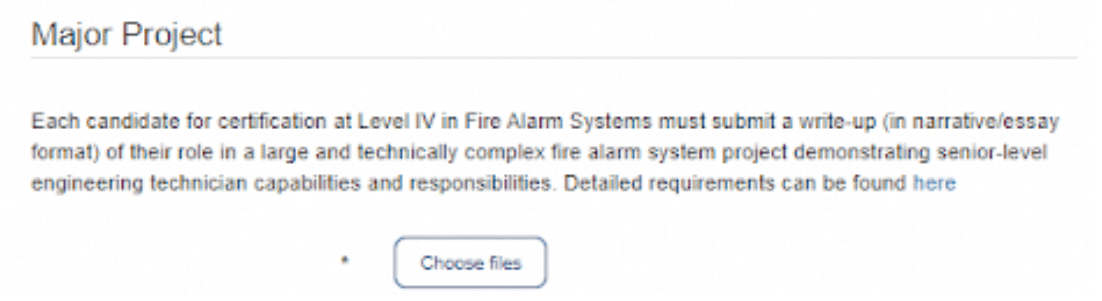
NICET does not explicitly state the required size of the project; it only includes “substantial complexity.” The type of building, system, or number of devices is not specified. NICET accepts a major project write-up on any project. The crucial aspect is the applicant’s supervisory role in the project from start to finish. NICET provides some general guidelines for the write-up and your role.
- The project must be recent (within the last 4 years)
- Your involvement must include a range of activities
- You must document your role in the project, including direct responsibilities and delegated
- You must show a high level of understanding of various aspects of the project
- Document your supervisory responsibilities
- Document your activities involved with the project
- Note the location, type of system/project, and purpose of the system/project
- Size of the facility (square footage, stories, etc.)
- Time period (stop/start dates, amount of time you were involved)
- Scope of the project (number of circuits, devices, special circumstances)
The project write-up must be submitted in typewritten form through NICET’s website. The write-up is required before Level IV Certification is granted, even if all testing and experience requirements have already been met. The senior technician’s role is important to remember in this project’s write-up. Since this is a write-up for a senior-level project, a technician with 10 or more years of experience was involved in a senior-level capacity. NICET uses this project to gauge experience as a senior-level technician. It is required above the testing, verification, and recommendation for Level IV Certification because a Level IV technician is the highest level of certification.
NICET expects a Level IV applicant to have supervisory experience and control over the major project. The applicant does not have to pull wires and install devices, but needs supervisory control over all aspects of the project. The applicant is involved at a high level in the design, installation, and commissioning of the system.
