

Passive infrared detectors are the most common form of motion detection used in modern security systems. The technology has evolved and become more reliable, but it still operates on the same basic principles. PIRs passively view an area and detect changes between the background temperature and any targets that enter the area. If the signal from the target is large enough, the unit goes into an alarm condition.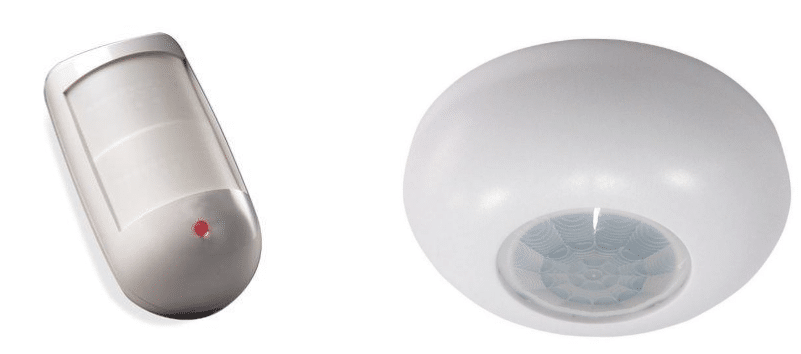
PIR detectors are available in wall-mount and ceiling-mount models. The mounting location is a consideration of the best location for detection and aesthetics. Generally, wall mount models provide better detection due to the detection method. They can be more easily mounted in a location favorable to detection. They can also be more easily located to avoid false alarm sources. Ceiling mount models provide a more discrete detection device and provide coverage looking downwards, which can overcome obstructions that may block detection by a wall mount unit.
PIR detectors use a lens to provide a detection pattern for the sensor. The lens divides the detection pattern into segments, commonly called fingers, for purposes of detection. The detection pattern of a PIR will typically consist of multiple fingers detecting at different angles from the detector and in multiple levels of detection. Each finger of detection is designed to detect a human-sized target at a specific distance from the detector. When a human-sized target enters the detection finger, it creates a strong enough signal in the sensor to cause an alarm condition in the detector.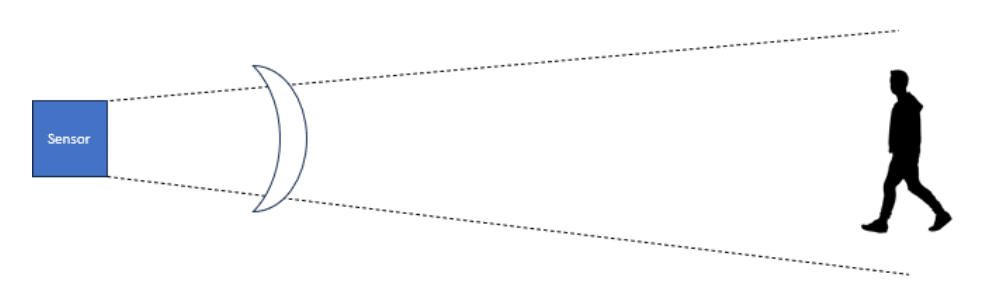
Detection Pattern
Passive infrared (PIR) manufacturers state the area of the PIR that the device can detect in terms of size (example: 40’ x 40’) or by distance and angle of the pattern (example: 40’ x 90°). Both are accurate representations of the pattern of detection. PIRs commonly have a shorter range or wide pattern or a longer range or narrow pattern. Both patterns may be accessible in the same unit (by changing lenses) or may be separate models.
An important part of PIR selection is to match the PIR pattern to the room. A PIR with a pattern too large for the room may result in the detection of fingers landing in undesirable locations (like windows or intermittent heat sources). Conversely, a PIR pattern that is too small may not provide detection in the entire room.
It is also important to remember that PIRs are line-of-sight devices. PIRs provide detection as far as they can “see,” meaning that obstructions will reduce the coverage area, and large open spaces may have detection beyond the rated range of the detector.
Matching the pattern of the PIR to the room size can present challenges since manufacturers offer limited options for available PIR patterns. The designer or installer should select the pattern that provides the best fit for the room being covered. After device selection, potential locations for the detector should be evaluated to determine what location will provide the best possible detection and the least chance of false alarms.
The detection pattern of the PIR should be reviewed to ensure that the detection fingers do not land on potential false alarm sources. Manufacturers’ data sheets and instructions will typically provide details of the coverage pattern of a PIR to help make this determination prior to device installation.
Wall Mounting
Most PIRs are designed to be wall mounted at 6-10 feet high. Using the appropriate mounting height is as important as using a PIR with the appropriate detection pattern for the room. PIRs are rated to cover a specific area based on their prescribed mounting height.
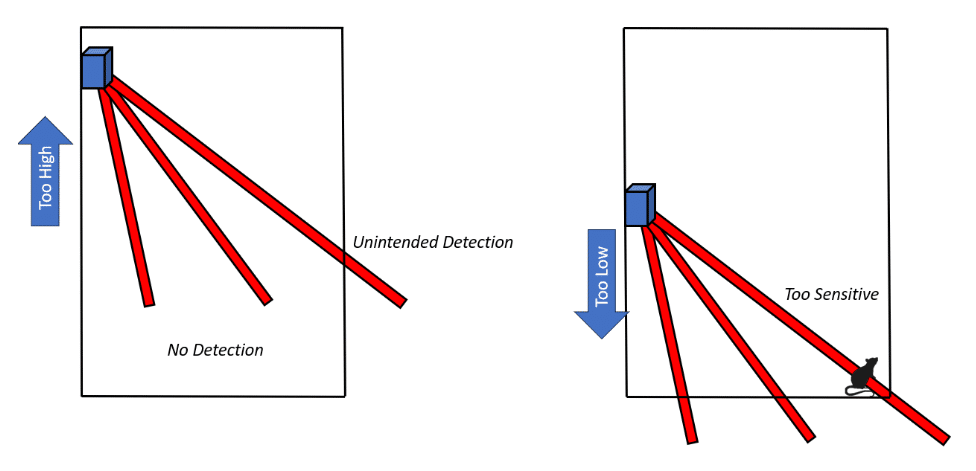
Mounting the unit too high results in a coverage area that may be larger than planned, which may provide detection in unintentional locations. A location that is not part of the planned coverage area for the detector could result in false alarms.
Mounting above the recommended mounting height could also result in no detection or reduced detection ability in the pattern. The detection fingers are designed to detect a human-sized target at a specific distance. However, as the finger gets farther from the detector, the area that the target must take up to generate an adequate signal for an alarm increases.
If you mount the unit too low, the coverage area may be smaller than planned, and the detector will be more sensitive than planned. Since the detection fingers are designed to detect a human-sized target at a specific distance from the detector, moving the detector close to the floor reduces the size of the finger that hits the floor and reduces the size of the target required to trigger the detector.
If higher mounting heights are required, a PIR with a greater mounting height range should be used. PIRs with larger coverage patterns will typically require a higher mounting height to achieve greater coverage of the device. However, if the larger coverage is not required, the larger pattern could present other problems for detection. Another option for higher mounting height requirements is to use a ceiling mount PIR instead of a wall mount.
Ceiling Mount
Ceiling mount passive infrareds (PIRs) provide coverage of a room from the ceiling downwards towards the floor. The coverage area extends in a 360° pattern from the mounting location of the PIR. Since ceiling mount PIRs have a circular coverage area, the detection pattern is typically stated using a single dimension: the diameter of the circle that the PIR covers.
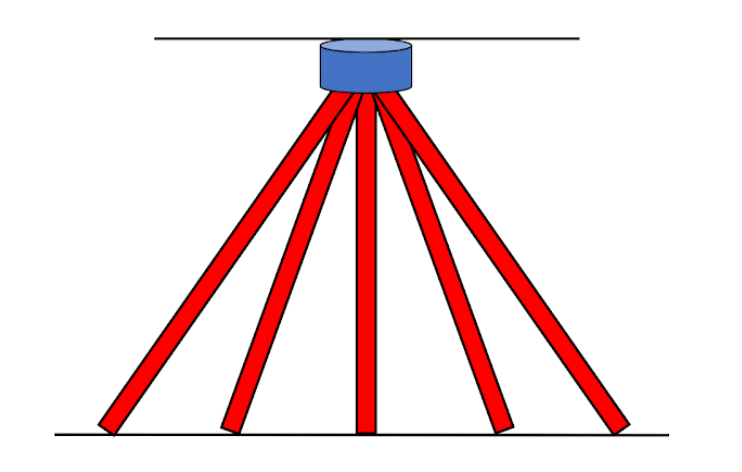
The mounting height of a ceiling mount PIR is an extremely important consideration when using a ceiling mount PIR. Ceiling PIRs have a pattern size based on a specific ceiling height, so changing the ceiling height impacts the size of the detection pattern. Manufacturers will typically state the effective coverage pattern of the PIR in the specification sheet. For example, a ceiling PIR may have a detection pattern of 25 feet when mounted on an 8-foot ceiling but a detection pattern of 40 feet when mounted on a 12-foot ceiling.
Installing a ceiling mount PIR on a ceiling above the maximum rated height of the unit reduces the unit’s sensitivity. Like wall mount units, the detection pattern is configured for a specific distance (mounting height), and exceeding that distance makes the unit less able to provide proper detection. Mounting height can be especially problematic in warehouse applications with high ceilings, which may require specific models designed for higher ceilings.
As with wall mount detectors, the detection pattern of a ceiling mount detector must also be considered during design and installation. The room should be evaluated using the manufacturer’s data sheet or instruction to determine where the detection fingers will land.
A ceiling mount PIR would typically be mounted in the center of the room to provide detection of the entire room. However, depending on how the detection pattern covers the room, the detector may need to be moved off-center, or the mounting may need to be rotated in order to provide the best detection and avoid potential false alarm sources.
Learn more about PIRs in the NTC Green Book – Intrusion Systems Handbook
