

NFPA 70 requires the installation of a surge protection device (SPD) on the supply side of the fire alarm control panel’s primary power. The purpose of the surge protection device is to protect the fire alarm system from transients and power surges that could damage the system or interfere with its proper operation.
Surge protection devices are classified as Type 1, 2, or 3. Type 1 devices are located at the main electrical service entrance for the building and are sometimes referred to as whole-building surge protection. Type 2 devices are installed at the electrical panel and protect the equipment served by that electrical panel. Type 3 devices are installed on the load side of the circuit breaker and are typically used to serve an individual piece of equipment on the circuit. Surge protection devices for fire alarm systems are typically Type 1 or Type 2. Surge protection devices protecting fire alarm systems are required to indicate that they are functioning properly.
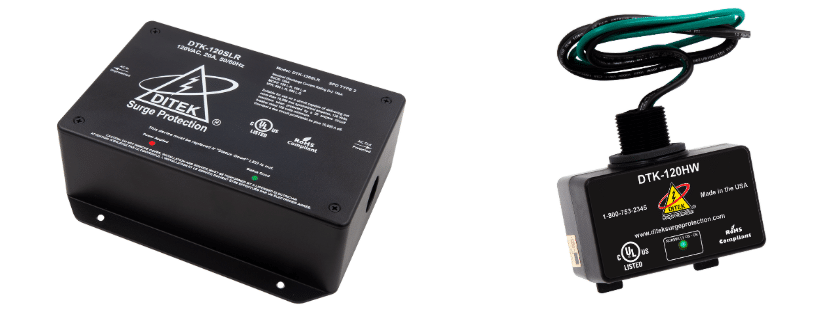
While NFPA 70 requires surge protection for primary power to the fire alarm system, secondary surge protection for fire alarm circuits provides an additional layer of protection to the system. Fire alarm initiating (IDC), notification (NAC), and signaling line (SLC) circuits present additional points of entry into the fire alarm system for transients and surges. The risk is even greater if these circuits are run outside of the building to interconnect control panels or to supervise outdoor sprinkler valves. Additionally, supervising station communications pathways, such as telephone lines for a DACT or the internet connection for an IP communicator, may also expose the fire alarm system to transients and surges.

Surge Protection Selection
When selecting surge protection for fire alarm system circuits, it is essential to evaluate the equipment for its suitability for use with the fire alarm system. Surge protection devices have service and clamping voltages, which should be in line with the operating voltage of the circuit being protected. Surge protection devices with visible indications enable the status to be verified at a glance, and an audible indication provides an additional method of notification in case of device failure. Surge protection devices with replaceable modules enable a failed module to be quickly replaced without requiring reconfiguration of the equipment.
It is also important to remember that surge protection is only as good as the ground it is connected to. Surge protection devices without adequate grounding do not provide a viable alternative path for the transient or surge, leaving it to travel through the fire alarm panel.
Article 250 – Grounding and Bonding
While NFPA 70 does not require fire alarm systems to be grounded, grounding the system is a requirement of most fire alarm control panels, allowing the system to detect ground faults. Additionally, the availability of a ground connection allows for the proper installation of a surge protection device.
In most instances, the fire alarm contractors ground their system as directed to an appropriate ground electrode connection. The connection may be to a specific location or a ground bus bar. NFPA 70 permits multiple electrodes for grounding, including:
- Metal underground water pipe with 10 feet of earth contact
- Metal in-ground support structure with 10 feet of vertical earth contact
- Concrete-encased electrode with 20 feet of ½ inch rebar or 4 AWG copper wire
- Ground ring encircling the building with at least 20 feet of 2 AWG bare copper wire
- 8’ rod or pipe electrode, either ¾ inch steel pipe or conduit, or 5/8” steel or copper rod
- Plate electrode with 2 s.f. of soil contact and ¼ inch thick
NFPA 70 requires that buildings with multiple grounding electrodes be bonded (electrically connected) together.
The Code requires that grounding conductors be green or green with yellow stripes. If a ground clamp is used, it must be listed for the material of both the grounding electrode and the conductor. Only a single conductor is permitted per clamp or fitting, unless it is listed for multiple conductors.
NFPA 70 does not specify a minimum wire gauge for grounding wire for fire alarm panels; therefore, the manufacturer’s instructions should be consulted. Typically, the manufacturer recommends a minimum of 14 AWG. The grounding wire gauge of surge protection devices depends on the location of the surge protection and the amperage of the circuit it is protecting.
