The word “listed” appears throughout NFPA 72 and is a term we use regularly in our discussions about fire alarm systems. “Listed” is a key term in fire alarm work that many fire alarm professionals do not fully understand.
A discussion of the word “listed” in the context of fire alarm systems should begin in Chapter 3 of NFPA 72, where listed is defined. In NFPA 72, listed in one of the first definitions identified under NFPA Official Definitions:
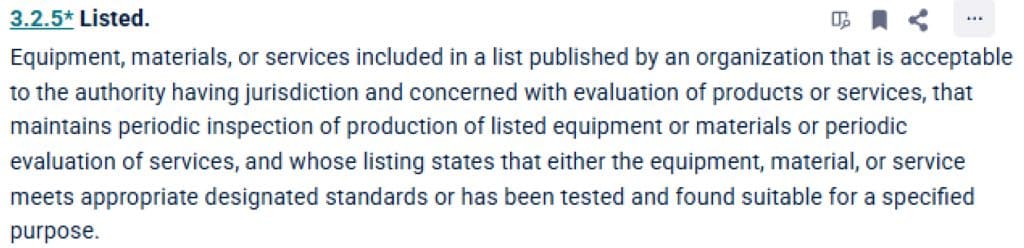
The word “listed” has a broad application in NFPA 72, covering equipment, materials, and services. “Listed” means that the item in question is included on a list published by an organization acceptable to the authority having jurisdiction (AHJ), which performs a function of evaluating the item and states that it meets the appropriate standard or has been found suitable for a specific purpose. “Labelled,” which is also defined in the same section, indicates that the item bears an identifying mark from the organization that has “listed” the equipment.
One important thing to note about the definition of listed is the absence of the words “NFPA” or “UL.” NFPA does not evaluate or approve equipment for fire alarm systems; rather, it defines the requirements for installation and operation. While UL is a listing agency and evaluates and approves equipment for fire alarm systems, it is up to the AHJ to determine whether UL is the listing agency they will accept. While UL is the most recognized organization for fire alarm equipment listing, it is not required by NFPA 72.
Chapter 10 of NFPA 72 requires that equipment used in a fire alarm system be listed for the purpose for which it is used, which applies to the equipment’s purpose, how it is used, how it is mounted, and the environment in which it is used. For example, manual fire alarm boxes (pull stations) are typically UL 38 listed. While UL 38 details the purpose, construction, and use of the device, NFPA 72 specifies the mounting requirements (height and spacing) and acceptable environmental range.
Most manual fire alarm boxes are listed for use in environmentally controlled locations. Where a manual fire alarm box is located directly outdoors (without a protective cover), the device must be specifically listed for outdoor use. UL 38 has performance tests for these devices, including water spray, temperature, and humidity testing.
NFPA 72, Chapter 10, also requires that devices receiving power from the initiating device circuit (IDC) or signaling line circuit (SLC) be listed for use with the control unit. This listing between the device and control unit ensures the devices are compatible and that the control unit can recognize signals from the device.
The requirement for compatibility between the initiating device and the IDC typically applies to conventional 2-wire smoke detectors. Conventional 2-wire smoke detectors receive their power and transmit signals over the same pair of wires. Conventional 2-wire smoke detectors are specifically listed for compatibility with the control panel they are used with, and the listing also specifies the maximum number of detectors that can be supported on a zone.
A listing is required because 2-wire smoke detectors generate an alarm signal on the panel by increasing their current draw during an alarm. The listing ensures that the panel will recognize the change and trigger an alarm. The listing also specifies the maximum number of detectors that may be supported in a zone without overloading the control panel.
The listing requirements for SLC (addressable) devices ensure that the control panel can communicate with the devices on the SLC. Since different manufacturers and control panel models may use different communications protocols, this listing ensures that devices connected to the SLC can be recognized and monitored for presence and status by the control panel.
Learn more about fire alarm systems and code requirements in the NTC Brown Book.